This is the seventh blog post regarding the 10 Things I Accidentally Learned on the Path to Growth. There is little question that many folks in our industry seem to feel that the vendors are the enemy. Why - I am not exactly sure. But I can tell you without question that an attitude like that is 180 degrees the wrong way. Not only are vendors necessary and important - if you really want to grow - they are one of the most important factors I have seen and experienced.
So before you tune me out - listen a bit. Unless you are some super giant company - you do not have everything you need in order to serve your clients. Even Microsoft and HP use vendors - lots of them - to bring together things needed to serve their end clients. So what makes us as IT owners believe we are self sufficient and can run our business without any vendor relationships? I know the answer and it is in one word - stupidity! I know because I used to think that way a long time ago. I thought my job for the day was to beat vendors and distributors up on pricing and accuse them of trying to take my customers or take advantage of me through one of their programs somehow. Is that how you see your vendor relationships? Wrong approach - way wrong. Here are the facts as I have seen them over the years:
Vendors and Distributors exist to sell stuff
At the core of our attitude toward vendors is the failure to understand what they are in business for. Just like us - they exist to make a profit - and serve their customers. We tend to want to cut that first part out. If you want to succeed in this area - you have to understand that they are in business to sell things. And the way you embrace that is pretty obvious - you buy them. But not based on where you can find the lowest deal of the day or beat down the last penny of profit. You consolidate your purchasing and become a loyal buyer. Nothing says relationship like those two words. Get over finding the cheapest place to source products. Pick a distributor and a few key vendors and buy their products the same way from the same companies every day. I am often amazed at discussions where someone saved $10 a product by shopping. They wasted two hours of valuable time that could be used on productive work - but they got the best deal. Until they look a little more and find out that had they spend the whole day they could have saved $12. How ludicrous. We are in the value business. We sell our solutions and services based on value - not cost. We should buy the same way and quit worrying about getting every last dime out of someone. You will never grow or succeed as long as you are focused on spending your time here rather than building value for the customer.
Learn who your reps are and how they get paid
Relationships happen between two people. Every vendor has people resources that we can leverage to help drive our collective business. Your assignment is to find out who they are and build a relationship with them. It starts by buying as described in the previous paragraph. Most vendor reps are not crazy about working with companies that don't buy anything. But assuming you figure that one out and become a loyal partner - then it is time to begin the treasure hunt to find out where the people resources are. This takes determination and hard work - but is very much worth the effort. Once you build a relationship by consistently executing - you will find that these folks offer to bring resources to the table to help you grow. After all - they are paid on selling stuff. You need to ask that question and understand their compensation model - but inevitably it will have some component of sales in the mix. So find them and help them succeed. No one in their right mind won't partner with you to sell more if you are helping them earn more. This is key - building a win - win relationship. It is so powerful and I have seen significant results from learning to partner closely with vendor reps.
Participate in their programs
Vendors spend millions and millions of dollars on our behalf. The sad reality is that most of us don't take advantage of those investments. We don't like what they are offering for this reason or that - so we just ignore them. Bad decision. We need to not only understand what our key vendors are doing to support the channel - we need to participate in every possible way whether it is exactly how we would like it or not. It is their money after all. They are spending it on our behalf. We don't get to decide how. But they do care about our participation. They very much care about how involved we are in taking advantage of their investments. And they do keep score. Not getting much attention from your vendors? Begin by looking at your support and participation in their programs. More often than not you are getting what you deserve based on your committment.
Provide customer evidence
Vendors really love customer success stories. And in our IT channel two tier distribution model they have a difficult time getting those because we are in the middle. If you want to win some big points with both field reps and folks at corporate offices of your key vendors - capture and write success stories on how their technology delivered by you made a difference. That is like gold to reps and gives them some great evidence to bring back to their company. You can use it with your customers too - so it is something we should all be doing anyway. Just be sure to include your vendor reps and help them look good with their managers.
Get your team trained
It amazes me at how many partners complain about having to invest in training to get attention from vendors. Is it really that difficult to understand. It not only prepares us to actually sell their products as designed, to install them the best possible way, to succeed with their programs and use their references - but it also shows loyalty and our willingness to put skin in the game. Do I ever think some of the training is a little worthless? Yep. Do I think most training could be done better? Yep. Do we participate and get our people trained? Absolutely. Why? Because it shows that we are committed to the technology and company we are representing. It is part of learning how they intend to help us succeed. We need to bite the bullet and get our people trained, and then use what we learned to sell and implement more solutions.
Plan and be accountable to them
One of the most important things you can do to take vendor relationships to a whole different level is to truly plan together. Each year in the last quarter we hold our annual vendor planning session. We invite our top 4 or 5 vendor partners and our disty partner to the table - all at the same time - with our management team to strategize for the coming year. This has turned into one of the most important things we do to drive relationship with our vendors. It is a day and a half to two days focused on how we collectively grow each others business. There are competitors in the room - but we are clear that our approach to the market is solution selling and we sell products from a few vendors to build our solutions so they have to learn to play together in the sandbox. It opened some eyes the first time we did it. Some were pretty quiet and careful - but over the years it has become a true collaborative time and vendors leave knowing our collective approach. We also make committments to them, and they to us, that both sides are accountable for. We do quarterly reviews to make sure we are on track through the year. You have to be transparent and accountable if you truly want to make vendor relationships work.
There are lots of ways to engage vendors. Here are a few ideas we have utilized:
•Marketing Development Funds (MDF) - come in a variety of shapes and sizes
•Technology adoption programs
•Rapid deployment programs
•Beta programs
•Case studies – video and print
•Advisory councils
•Technical and sales training
•On site visits where we have corporate folks in our office to see what really happens
The bottom line
If you want to truly grow your company - you have to get this area right. I have seen NO company of any size do it alone. There always is a very strong and deep strategy to leverage vendors as part of the growth. You just aren't going to get there if you don't embrace them. They truly are a great resource and ally if you build deep relationships. It is work. It takes time. But it is very much worth it. Get after it and don't listen to the majority who will never figure this out. Go deep and find out just how far great vendor relationships can take you on your path of growth!
Showing posts with label Strategy. Show all posts
Showing posts with label Strategy. Show all posts
Monday, December 27, 2010


Sunday, December 12, 2010
Growth is Hard Work
This is the fifth blog post regarding the 10 Things I Accidentally Learned on the Path to Growth. There is little question that many small business owners really don’t understand just how difficult the growth process really is. The common misconception is that if you show up every day and work hard – it just happens. That has not been my experience. There are many steps along the path to growing a business, and it must be done intentionally and executed continually to keep moving forward.
It all starts with you. You started your business because you wanted to be your own boss. You wanted to call the shots. There is a likelihood that you worked for someone else and decided you could do it better. But when you make the decision to grow – it can’t be about you anymore. Growth means you have to involve others – inside and outside your company. And that is the first step. You have to hire someone.
I remember those days well. It was a scary proposition. All of a sudden I was responsible for payroll which meant we had to be generating revenue. I sort of convinced myself it was ok to work some of the time and not pay myself – after all it was my company. But when you bring on that first employee they typically don’t quite see it that way. They come to work with the expectation they will get a paycheck and they should. So we have to know how we will generate enough revenue and keep them busy so we can pay them.
This is usually when the first lesson of growth occurs. It isn’t a straight line up. We have steps – take a few forward and then one backward. It looks something like this for many:
 Seldom do companies grow with the green line – just up and to the right continually with no hiccups. Nor do companies maintain their situation like the red line – stagnant without change. I am a believer that if you are not growing – you are shrinking because I seldom if ever see a company just stay the same. But growth is a series of ups and downs and that is normal. It isn’t a mistake – and there isn’t anything wrong with you when it happens – it is the reality of how growth occurs.
There are a half dozen key stages I see in the growth cycle. The following chart shows some of them and areas where they may show up in your growth pattern.
 You won’t necessarily experience all of these in the same order or at the same level as the chart describes, but as you grow your IT firm you are likely to experience all of them along the way.
That takes us to the second step – which is the need to become a sales organization. To be totally honest – this is the one where many companies get hung up. It may happen with 2-3 employees or you may make it to 7-8, but at some point sales will be your blocker to growth. Why? Nothing happens until someone sells something. I will go into much more detail on sales in a future blog post. It is essential, so embrace it and accept the fact it has to happen if you want to grow.
This is the first of what I consider to be the five key areas to growth:
1. Become a sales organization
2. Learn how to market
3. Put in place and execute process
4. Develop leadership
5. Understand the power of strategic relationships
My experience is that if you understand and work through these key blockers – you will grow and grow significantly. But each one can plateau you for years or for life. You can’t skip any step – the order may change – but all are essential to continually growing your company.
Realize that your business should serve you – not the other way around. If the business controls your life – you have a job. You probably left a job to start your business so don’t just trade one for the other. Dreams should be coming true. You should have more freedom – not less. It has to function without your presence – if you are required to make it work – you have a job with a different title on it. It should be predictable in meeting your goals and needs. It should not require you – or the 4 P’s from you:
· Your presence
· Your personality
· Your problem solving
· Your persperation
As you build your sales organization you begin to feel like you are losing control. Not everything goes through you anymore. You have to trust others. It is a huge step. But if everything flows through you – then you are the bottleneck to growth and not only will you restrict that – you restrict profit potential as well. You cannot be the center of your company forever. The only way you escape the problem is to keep growing and putting others in places you once were responsible. That is called delegation – not something many entrepreneurs are comfortable with – because no one does it quite like we do. But we have to get over that and let others do the work.
So you have began to build a sales team and hired a sales person or two. They are selling and then hit the wall. They run out of people they know and places to call on. That is when marketing has to kick in. Marketing is key to keeping a sales team productive. They don’t manufacture sales – they close leads and turn them into sales. Many small business owners make the mistake of thinking that just hiring a sales person fixes all the sales issues. In fact it just creates more needs. They have to be closely managed and there has to be a consistent lead generation system to keep them productive. They can’t just make this stuff up. It has to be fed to them so they can do what they do – go build relationships and close deals. That is what we hire them to do so now we have to equip them with the tools they need for success.
Next comes the need for some sanity in the midst of chaos. Many companies go for years without any process, procedures or policies in place. And then as they have some success and grow – things quickly get out of control because you can’t scale without processes. So in the teens for number of employees you have to get things written down and folks trained to follow them. It is hard work. We never have time for it. And changing behavior to follow is a difficult task because we are upsetting their world. Why do we need this all of a sudden? It is far easier to do this step early with few employees than wait for the chaos to require it. But most of us don’t make the time until it is mission critical. And that is driven as we grow to a certain point. Take it from me – it is far easier to write a process for two than for twelve. Do it early – do it well – and set the example to follow them.
After some more growth and success we begin to run into a leadership void. We typically expect our people to learn by osmosis and just being around us. Unfortunately it doesn’t quite work that way from my experience. So we have to make investments and train folks on leadership. That is essential as we will need to grow practices around key technologies, vertical markets or opportunities. Many companies don’t have nearly the leadership they need to continue growing. It is a sad reality. It happens because we have been too cheap to invest and too busy to notice than no one else is really stepping up to lead. This costs money and takes time – intentional and significant time – which far too many small business owners never take. We seldom invest in our own skill building let alone that of others. But if we want to keep growing we have to build leadership and a team that can help make that happen.
At some point along the curve we grow past our ability to drive continued growth on our own. That is when the value of strategic relationships kicks in gear. I find it happens somewhere past 50 employees and it becomes essential to learn to leverage the investment other partners in the ecosystem are making. We need to use their marketing, lead generations, services and tools to help to continue drive the business. But it is all about building and maintaining strong relationships. It won’t happen accidentally and I find this one area to be a key blocker for many companies that are trying to grow. More on this topic in a future blog post as well.
Growth has many steps. They don’t all move upward and to the right. It is hard work and requires determination, dedication and a very big desire. But you can grow if you truly want to and commit to it. We have experienced it even on the farm in Iowa where our business is operated. It isn’t magic – it is hard work and execution day after day to work toward a strategic objective. Plan for growth and then execute to achieve it. Realize it means change often along the way. But you can achieve it if you want to!
Sunday, November 14, 2010
Strategy Matters
This is the first blog post regarding the 10 Things I Accidentally Learned on the Path to Growth and is a topic many of us as small business owners take for granted. After 25 years in this business, it has become more apparent than ever that strategy truly does matter. It isn't how things typically start. Certainly not in my case.
Many of us began our businesses because we were good at what we did and decided we could make a business from it. We are typically good technically or as sales people and begin to hire a person or two to help us serve more folks. In my case, I started the technology business as a hobby because I really enjoyed computers. 1985 was the start and there was not grand plan, no long range strategy, just myself and my bride (who wasn't all that sure of the idea) that started to sell and service Apply computers.
It was just me for the first five years and then I hired my first employee - which changes everything. No longer can I just do whatever whenever and be able to expect others to read my mind. That is how I tended to run things for quite some time. But osmosis doesn't really work, and people can't read my mind, so it was time to begin making some changes.
Over the years I have had to change how I lead. And one of the major adjustments has been to define and let people know about strategy. That requires thinking about things far beyond the normal day to day tactical operations which is where most small business owners are most comfortable. After all, we can fix most anything and sell what we need to without a strategy can't we? That is true for a while, but soon you hit a ceiling and one major reason is that others are not sure what the plan is or how to really help the company grow.
We have to identify that "house on the hill" or "BHAG" as it is oftened called if we want others on our team to be able to help join us in taking the company there. They can't just figure it out as we often think they should. It needs to be defined and written and shared. It must be measured and updated and adjusted. It is hard work but vital to keep the company growing.
What it really means is that we must begin to think like a CEO. There are bad connotations to that role today, but it isn't the role that is an issue, but the people who fill that seat. For many small businesses - no one is sitting in that chair and no strategy happens. CEO thinking is strategic. It is forward looking and future facing. It is very different from how most of us are wired today. But it is critical. Here is a table showing some of the areas I believe we need to consider and the differences in the role of CEO think vs President or GM think.
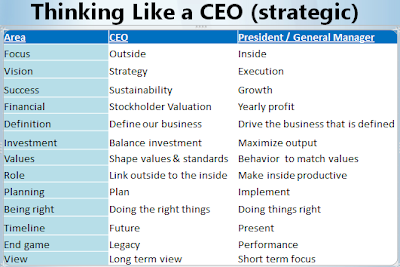
We don't default to thinking like a CEO as the entrepreneur that founded the company. That is somewhat foreign territory for us. But if we want to take our company to the next level, we have to learn to think differently. We must begin to think strategically. That transformation does not happen overnight. It takes time and effort and a desire to learn. But it can happen, and when it does, your company will be poised to go to the next level.
Many of us lie about whether we truly have a business when the reality is we really just have a job. The way to transistion from a job that makes us......
CEO thinking is not easy - but it is essential. HTG is committed to helping our members get there. We hold our CEO Forum twice a year to help focus owners on transitioning from the day to day to strategy. That is the leap we must make.
Many of us began our businesses because we were good at what we did and decided we could make a business from it. We are typically good technically or as sales people and begin to hire a person or two to help us serve more folks. In my case, I started the technology business as a hobby because I really enjoyed computers. 1985 was the start and there was not grand plan, no long range strategy, just myself and my bride (who wasn't all that sure of the idea) that started to sell and service Apply computers.
It was just me for the first five years and then I hired my first employee - which changes everything. No longer can I just do whatever whenever and be able to expect others to read my mind. That is how I tended to run things for quite some time. But osmosis doesn't really work, and people can't read my mind, so it was time to begin making some changes.
Over the years I have had to change how I lead. And one of the major adjustments has been to define and let people know about strategy. That requires thinking about things far beyond the normal day to day tactical operations which is where most small business owners are most comfortable. After all, we can fix most anything and sell what we need to without a strategy can't we? That is true for a while, but soon you hit a ceiling and one major reason is that others are not sure what the plan is or how to really help the company grow.
We have to identify that "house on the hill" or "BHAG" as it is oftened called if we want others on our team to be able to help join us in taking the company there. They can't just figure it out as we often think they should. It needs to be defined and written and shared. It must be measured and updated and adjusted. It is hard work but vital to keep the company growing.
What it really means is that we must begin to think like a CEO. There are bad connotations to that role today, but it isn't the role that is an issue, but the people who fill that seat. For many small businesses - no one is sitting in that chair and no strategy happens. CEO thinking is strategic. It is forward looking and future facing. It is very different from how most of us are wired today. But it is critical. Here is a table showing some of the areas I believe we need to consider and the differences in the role of CEO think vs President or GM think.

We don't default to thinking like a CEO as the entrepreneur that founded the company. That is somewhat foreign territory for us. But if we want to take our company to the next level, we have to learn to think differently. We must begin to think strategically. That transformation does not happen overnight. It takes time and effort and a desire to learn. But it can happen, and when it does, your company will be poised to go to the next level.
Many of us lie about whether we truly have a business when the reality is we really just have a job. The way to transistion from a job that makes us......
- wear too many hats
- work too many hours
- handle too many things
- makes us a slave
CEO thinking is not easy - but it is essential. HTG is committed to helping our members get there. We hold our CEO Forum twice a year to help focus owners on transitioning from the day to day to strategy. That is the leap we must make.
Thursday, November 11, 2010
10 Things I Accidentally Learned
This past week I was in Orlando and shared at the IT Nation event hosted by ConnectWise. The topic was “10 Things I Accidentally Learned Along the Path to Growth”. Since I am one of the older folks in the industry, experience is on my side, and there have been some fairly painful learning experiences over the past 25 years. Ten of them stood out as significant – so that is what I shared. I will be writing in much more detail about these on this blog over the next few weeks – but here is the list and highlights for now:
1. Strategy Matters – we have to understand the "why" so we can set our sights on where we are going and know the outcome we pursue.
2. Planning is Key – we need to plan in at least 4 key areas – business, leadership, life and legacy – and the more we plan the luckier we get!
3. Leadership is Required – we have to grow as leaders both in our company and for our clients. We can’t lead people where we have never been.
4. Cash is King – our ability to grow and continue to lead in this industry can happen only when we have managed our cash well.
5. Growth is Hard Work – many think growth just happens. It doesn't. It takes a lot of continual effort and always is harder, slower and longer than expected.
6. Sell is Not a Four Letter Word – Ok - actually it is, but for many years I missed the boat on this one. Nothing happens until someone sells something. We have to become a strong sales organization.
7. Vendors Are Not The Enemy – we must learn to leverage their resources to help drive our business.
8. Success Without Balance is Empty – if we lose track of what matters and do not balance work and life – the results really don’t matter. We must manage our time and focus.
9. Keep Your Eye on the Customer – our marching orders come directly from them, not the latest fad or trend, and we must listen closely and respond quickly.
10. It is All About Relationships – we are in the people business actually helping folks with adapting to change. Boil it all down to this – we are in the change management business.
So that is my list – I probably forgot a few important thoughts along the way. The response has been overwhelming from those who heard it. As I sat down to create this presentation, it occurred to me that there are no items on the list that deal with technology itself. In the last 25 years some rather major changes have occurred. There was no Internet when we started. Cell phones were 20 pounds and not reliable. A portable computer was a luggable that weighed 40 pounds and was the size of your entire desk. IP telephony hadn’t even been thought of. Very little of the technology that we deal with today was even a glimmer in someone’s eye back in 1985. But the reality is that technology without a person using it has little value. It is about people and how they apply what we sell. We are in the people business – we must never forget that – and technology is just a tool we have to serve them. Our success will be measured by how well we keep our eye on that ball. Let’s make sure people are in the center of everything we do!
Subscribe to:
Posts (Atom)